
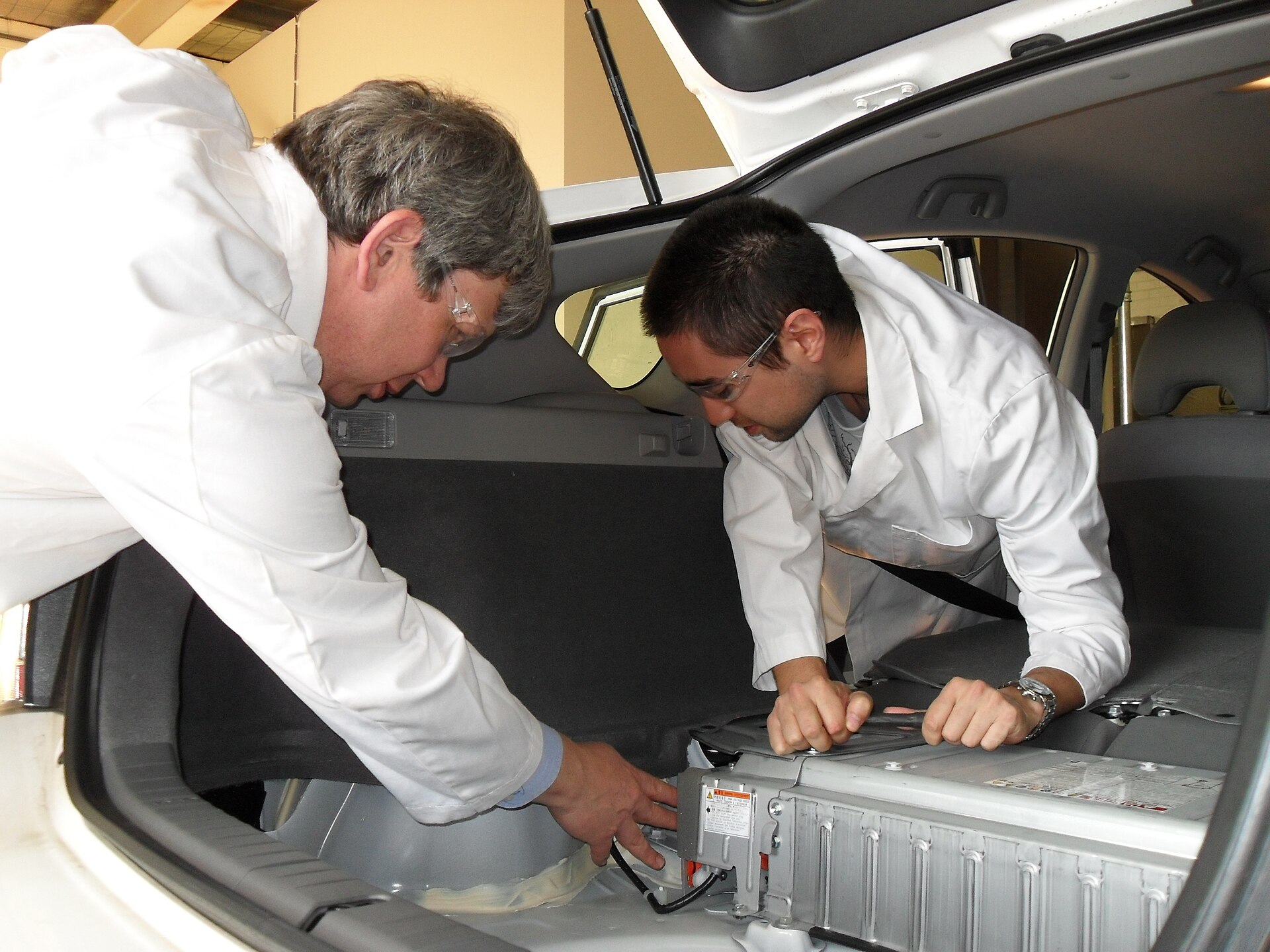
Toyota and Panasonic once targeted market maturity for solid-state batteries by 2025. That year has come and gone. As of September 2026 you cannot walk into a dealership anywhere in North America and buy an electric car with an all-solid-state battery, and no manufacturer has committed to a firm consumer delivery date inside the next two years.
This is not because the science failed. Solid-state cells work in laboratories, and several companies are shipping validation samples to automakers right now. QuantumScape’s QSE-5 B-sample prototype, for example, measures 844 watt-hours per litre and 301 watt-hours per kilogram, which is genuinely better than the lithium-ion cells in production cars.
The gap between “works in a lab” and “cheap enough to put in 400,000 cars a year” is where this technology has been stuck for a decade. It is worth understanding exactly what the obstacles are, because they explain why every announced date keeps moving and let you judge the next announcement for yourself.
What replacing the liquid actually changes
A conventional lithium-ion cell has four parts: a cathode, an anode (usually graphite), a porous separator, and a liquid electrolyte that soaks through everything and carries lithium ions back and forth. That liquid is typically an organic carbonate solvent, and it is flammable.
A solid-state battery replaces the liquid and the separator with a solid material that conducts lithium ions. Three consequences follow.
Safety. A ceramic or glass electrolyte does not burn. Thermal runaway in a lithium-ion cell is driven substantially by the electrolyte decomposing and feeding a fire; remove it and the failure mode changes character. This is the least contested benefit.
Energy density. The bigger prize is that a solid electrolyte may let you use a lithium metal anode instead of graphite. Graphite is essentially a sponge that holds lithium ions; it contributes weight and volume but no energy. Pure lithium metal stores far more charge per unit mass and volume. Liquid electrolytes react badly with lithium metal, which is why nobody uses it in mass-market cells. QuantumScape goes further with an “anode-free” design in which the cell is built with no anode at all and lithium metal plates out in place on the first charge.
Charging speed. Some solid electrolytes conduct lithium ions faster than liquids do, and lithium metal removes the intercalation bottleneck of pushing ions into graphite. QuantumScape targets a 10 to 80 percent charge in under 15 minutes, though targets are not measurements.
Solid Power lists design targets of 390 Wh/kg for a silicon-anode cell and 440 Wh/kg for a lithium-metal cell, against under 300 Wh/kg for the best cells in production cars today. If those numbers hold at production scale and cost, a given battery pack gets meaningfully lighter or a given car gets meaningfully more range. That is a real advance, not a transformation of the category.
The three chemistries, and what each one costs you
| Electrolyte type | Examples | Advantage | Problem |
|---|---|---|---|
| Sulfide | Li₁₀GeP₂S₁₂ (LGPS), argyrodites | Highest ionic conductivity, some exceeding liquid electrolytes at room temperature; soft enough to press into contact | Reacts with moisture in air; requires dry-room manufacturing; narrow electrochemical stability window |
| Oxide | LLZO, LAGP garnets | Chemically stable, wide voltage window, safe in air | Hard and brittle; usually needs high-temperature sintering; poor contact with electrodes; cracks under cycling stress |
| Polymer | Polyethylene oxide (PEO) blends | Flexible, cheap, made on existing roll-to-roll equipment | Low conductivity at room temperature; historically needed heating to work well; softer resistance to dendrites |
| Halide | Chloride-based | Good conductivity and formability, better humidity tolerance | Newest of the four; least industrial track record |
Most of the serious automotive programmes have converged on sulfides, including Toyota, Samsung SDI and Solid Power, which builds its whole business on sulfide electrolyte. Sulfides win on conductivity and on being mechanically compliant, which matters more than it sounds.
The manufacturing obstacles that actually matter
Dendrites
When lithium plates onto a metal anode during charging, it does not deposit evenly. It grows filaments, called dendrites, that push through the electrolyte and eventually create a short circuit between anode and cathode. A short circuit in a high-energy cell is a fire, or at minimum a dead cell.
The original hope was that a hard ceramic would simply block dendrites mechanically. It does not. Lithium finds grain boundaries, pores and microcracks and propagates along them, and the pressure it exerts as it grows can widen those flaws. Suppressing dendrites over a thousand cycles at automotive charge rates is the single hardest problem in the field.
Interfaces and voids
In a liquid cell, the electrolyte wets every surface automatically. In a solid cell, you have a solid pressed against a solid, and the actual contact area is far smaller than it looks. That raises interfacial resistance, which costs power and creates hot spots.
It gets worse in operation. Electrodes change volume as they charge and discharge, and lithium metal in particular is stripped away from the anode during discharge. If the electrolyte cannot follow that contraction, voids open at the interface, contact area shrinks further, and current concentrates in the remaining contact points, which accelerates dendrite formation. Some solid electrolytes also react chemically with the cathode or the lithium, building up a resistive layer over time.
Stack pressure
The practical fix for voids is to squeeze the cell. Solid-state cells typically need external stack pressure in the range of 1 to 7 megapascals, roughly 10 to 70 atmospheres, to keep the layers in contact.
This is a serious engineering constraint that rarely appears in press coverage. Maintaining several megapascals across a large-format automotive cell means adding steel or composite compression hardware to the pack, which adds mass and volume, eating into the energy-density advantage that motivated the switch. Reducing required stack pressure is a major research goal precisely because pack-level gains are what matter, not cell-level ones.
Cost and yield
Ceramic separator sheets must be thin, defect-free and produced by the square kilometre. A single pinhole is a short circuit. Sulfide production needs dry-room conditions far stricter than conventional cell lines, and dry rooms are expensive to build and run. Lithium metal is difficult to handle in volume.
Meanwhile the incumbent keeps getting cheaper. Conventional LFP cells were available under $70 per kWh in early 2024, and some purchasers reported figures near $56. Any new chemistry has to beat a moving target that has fifteen years of manufacturing learning behind it.
Who has announced what, and when
Read this table with the dates attached, because the dates are the story.
| Company | Stated position | Notes |
|---|---|---|
| Toyota | Said in June 2023 it would not use commercial solid-state batteries until at least 2027 | Holds the largest solid-state patent portfolio; earlier joint target with Panasonic was 2025 and was missed |
| Nissan | Targets launching an EV with all-solid-state batteries by fiscal 2028 | Developed in-house; no consumer model named |
| Honda | Announced a demonstration line for early 2024; later signalled market maturity by 2030 | Signed an agreement with QuantumScape on 18 June 2026 |
| QuantumScape | Began shipping QSE-5 B1 samples in October 2025 | July 2024 agreement with VW’s PowerCo targets 40 GWh/year; no consumer date |
| Samsung SDI | Built a pilot line in Suwon from 2022, first output 2023 | Sample cells to automakers; no confirmed volume date |
| Solid Power | Sulfide electrolyte supplier and cell developer with BMW, Ford and SK On | Publishes design targets, not shipped production specs |
| Mercedes-Benz | Invested in ProLogium (Jan 2022) and Factorial Energy (Dec 2023) | Factorial cites a 1,200 km demonstration drive on solid-state cells |
| Hyundai | Targets market maturity in the 2030s | Partnered with Solid Power and Samsung |
Now the pattern. Panasonic and Toyota aimed at 2025 and did not get there. Honda’s demonstration line was announced for early 2024. ProLogium, QuantumScape and WeLion all at various points targeted gigawatt-hour-scale production between 2022 and 2024, and none reached it. Wikipedia’s survey of the field is blunt: as of 2026 the solid-state battery market has not reached scalability or commercialisation, and many companies that announced products have not commercialised them.
There is also an active problem with unverifiable claims. In 2026, battery researchers examining published test data from one startup’s advertised solid-state cell concluded the results looked consistent with ordinary lithium-NMC cells, and noted the absence of capacity-fade and pack-level data. Cell-level numbers without cycle life, without pack-level integration and without independent testing tell you very little.
The competition nobody talks about
While solid-state has been five years away for a decade, the incumbent chemistries have improved substantially. This is the reason a delay matters so much: the target keeps moving.
LFP (lithium iron phosphate) was long dismissed as the cheap, low-energy option. CATL cells reached about 205 Wh/kg at cell level by 2024, and LFP accounted for roughly 57 percent of EV batteries globally in 2025, including about 79 percent in China. It uses no nickel or cobalt, tolerates more charge cycles, and is markedly safer than nickel-rich chemistries. CATL’s Shenxing LFP cell charges from 0 to 80 percent in about 10 minutes, and in roughly 30 minutes at −10 °C, which addresses the fast-charging argument for solid-state directly.
Sodium-ion attacks a different flank. CATL’s Naxtra cell reaches about 175 Wh/kg, close to LFP’s 185, supports 5C charging, is rated for over 10,000 cycles and retains 93 percent capacity at −30 °C. It passed safety certification in September 2025 and entered mass production in December 2025, with a Changan model carrying a 45 kWh Naxtra pack planned for mid-2026. Sodium is abundant and cheap, though packs were still around 30 percent more expensive than LFP in 2025 because volumes are small.
Semi-solid and gel cells occupy the middle. They replace most of the liquid with a gel or polymer while keeping a small amount to solve the interface problem. They are easier to manufacture on adapted existing lines and give a partial energy-density gain. They are also, in an important sense, an admission that fully removing the liquid is very hard.
Cold weather is a genuine caveat for Canadian buyers. Both LFP and solid-state cells lose capacity in the cold, and solid electrolytes conduct ions more slowly at low temperature, so anyone promising that solid-state will fix winter range should be asked for low-temperature cycling data specifically.
What this means for you
- Do not delay an EV purchase waiting for solid-state. On current evidence, a mass-market solid-state vehicle you can walk in and buy in North America is unlikely before the end of this decade, and quite possibly into the 2030s.
- If a car you are considering has an LFP pack, that is not a downgrade. It is usually longer-lived, safer and cheaper. Check whether the manufacturer recommends charging to 100 percent, since LFP tolerates it better than nickel chemistries.
- Judge announcements by three things: whether the cell is a lab coupon or an automotive-format cell, whether cycle life at automotive charge rates was published, and whether a named vehicle and model year exist. Most announcements fail all three.
- Watch for pack-level numbers, not cell-level. A 400 Wh/kg cell that needs a heavy compression frame may deliver an ordinary pack.
- Expect the first products in small, high-margin applications, such as aviation, defence, premium models and consumer devices, before family cars. Factorial’s recent orders have come from aerospace rather than automotive.
Frequently asked questions
Will solid-state batteries double EV range?
Almost certainly not on first-generation products. Realistic cell-level improvements are in the range of 30 to 70 percent over today’s best cells, and pack-level gains will be smaller once compression hardware and thermal management are counted. Doubling is a marketing number, not an engineering one.
Are solid-state batteries actually safer?
The non-flammable electrolyte is a real advantage, and this is the least disputed claim in the field. A cell can still fail badly through internal short circuits from dendrites, so “safer” is not “cannot fail.”
Why do the timelines keep slipping?
Because the hard part was never the chemistry, it was manufacturing large-format cells at high yield, at low cost, with dendrite-free cycling and manageable stack pressure. Lab success on a coin cell does not predict a production line.
Is sodium-ion a better bet than solid-state?
For cheap, cold-climate and stationary storage applications, sodium-ion is shipping now while solid-state is not. For long-range premium vehicles, solid-state remains the more interesting technology if it arrives. They serve different ends of the market.
Which company is most likely to ship first?
Nobody honestly knows. Toyota, Samsung SDI and the Chinese cell makers have the manufacturing depth; QuantumScape and Factorial have automaker validation contracts. Any confident answer to this question is speculation.
How to read the next announcement
Solid-state batteries are a legitimately promising technology being marketed dishonestly. Both halves of that are true, and holding both at once is the only way to read this field usefully.
The engineering questions are specific and answerable. Does the cell hold up over a thousand automotive-rate cycles? What stack pressure does it need, and what does the compression hardware weigh? What is the yield on the separator line? What does it cost per kilowatt-hour at volume, against LFP at under $70? When one of these companies publishes those four numbers for a full-size automotive cell produced on a real line, the technology will have arrived. Until then, every announcement is a sample shipment, a partnership, or a target date, and the last decade tells you exactly how much weight target dates carry.
Sources
- Wikipedia — Solid-state battery
- QuantumScape — Technology and QSE-5
- Wikipedia — QuantumScape
- QuantumScape Investor Relations — press releases
- Solid Power — sulfide electrolyte technology and cell designs
- Factorial Energy — solid-state cells and partnerships
- Wikipedia — Sodium-ion battery
- Wikipedia — Lithium iron phosphate battery
- Wikipedia — Contemporary Amperex Technology (CATL)
- Wikipedia — Samsung SDI
- Wikipedia — Electric vehicle battery
Image credit: Photo: division, CSIRO — CC BY 3.0 (via Wikimedia Commons)
