
In January 2026 the average battery in a smartphone sold worldwide held 5,291 mAh, according to Counterpoint Research. That is roughly 400 mAh more than a year earlier, the largest year-over-year jump the firm had recorded since December 2021. Phones with batteries of 6,000 mAh or more went from about 10% of global sales in January 2025 to 29% a year later.
Something changed, and it was not a breakthrough in the sense that word usually gets used. Lithium-ion is still lithium-ion. What changed is the anode: manufacturers started blending silicon into the graphite side of the cell, which lets them pack more energy into the same physical volume. Six of the ten best-selling phones in that 6,000 mAh-plus segment used silicon-carbon cells.
This article explains what is actually happening inside your phone’s battery, what silicon-carbon genuinely buys you, what it quietly costs, why fast charging makes heat, and which of the battery-care features on your phone are worth turning on. Where numbers are contested or manufacturer-supplied, that is flagged.
What a lithium-ion cell is doing when you charge it
A lithium-ion cell has two electrodes separated by an electrolyte. The cathode is a lithium metal oxide, typically some blend of nickel, manganese and cobalt in a phone. The anode has traditionally been graphite. Charging pushes lithium ions out of the cathode, through the electrolyte, and into the layered structure of the graphite, where they sit between the carbon sheets. Discharging reverses the flow, and the electrons that travel the other way through your phone’s circuitry are what run the screen.
Two numbers describe how much a cell can hold. Capacity in milliamp-hours (mAh) is what marketing quotes, but it is only meaningful alongside voltage. Watt-hours (Wh) is the honest figure, and it is mAh multiplied by nominal voltage divided by 1,000. Apple’s EU energy label for the iPhone 17 Pro Max, for instance, lists 19.772 Wh, which works out to 5,088 mAh at 3.886 V nominal.
A third component matters enormously and gets almost no attention: the solid electrolyte interphase, or SEI. On the first few charges, some electrolyte decomposes on the anode surface and forms a thin passivating film that lets lithium ions through while stopping further breakdown. Nearly every mechanism that kills a phone battery traces back to that film being damaged and rebuilt, consuming lithium each time.
What silicon-carbon anodes actually change
Graphite has a theoretical specific capacity of about 372 mAh per gram. Silicon, which stores lithium by alloying with it rather than slotting it between layers, is roughly an order of magnitude better. Android Authority’s technical explainer puts the commonly cited theoretical figure for silicon at around 4,200 mAh per gram.
The catch is physical. When silicon takes on lithium it swells enormously. Published estimates vary depending on the phase assumed, and you will see figures between roughly 300% and 400% quoted; Engadget’s August 2026 explainer uses about 400% against graphite’s roughly 10%. Either way, a material that quadruples in volume every charge and shrinks back every discharge will crack, pulverise itself, and tear the SEI open repeatedly.
So nobody ships a pure silicon anode. “Silicon-carbon” means a composite: silicon in nanostructured or porous-carbon-encapsulated form, mixed into a mostly-graphite anode. The carbon scaffold gives the silicon room to expand internally without deforming the electrode. Silicon content in shipping phone cells is modest, and manufacturers rarely publish it. Android Authority’s estimate of the resulting gain is a 10% to 20% increase in energy density depending on how much silicon is used. That matches what you see in products: not a doubling, but enough to fit 6,000 or 7,000 mAh into a chassis that previously held 5,000.
Which phones actually ship silicon-carbon cells
Adoption is heavily skewed toward Chinese manufacturers, and Counterpoint noted that six of the top ten sellers in the high-capacity segment were China-exclusive models. The highest-capacity mainstream phone in its January 2026 ranking was the HONOR X70 5G at 8,300 mAh with 80W wired charging.
| Phone | Battery | Anode type |
|---|---|---|
| OnePlus 15 | 7,300 mAh | Silicon-carbon |
| HONOR X70 5G | 8,300 mAh | Silicon-carbon (third-gen “Qinghai Lake”) |
| Samsung Galaxy Z Fold 8 / 8 Ultra | Not disclosed | Silicon-carbon (percentage undisclosed) |
| iPhone 17 Pro Max (eSIM) | 5,088 mAh | Conventional graphite |
| iPhone 17 Pro Max (physical SIM) | 4,823 mAh | Conventional graphite |
| iPhone 17 Pro (eSIM / physical SIM) | 4,252 / 3,988 mAh | Conventional graphite |
Two things there are worth pausing on. Apple has not adopted silicon-carbon, and neither had Google as of mid-2026; the iPhone 17 Pro reached its capacity largely by deleting the physical SIM tray, and the eSIM-only variants genuinely hold more.
Samsung’s move is the more significant one. Per Engadget, Samsung began using silicon-carbon material in the Galaxy Z Fold 8 generation, where thickness constraints make the density gain worth the trade-off. Foldables are exactly the use case silicon-carbon was made for.
The trade-off manufacturers do not put on the box
Silicon-carbon cells appear to wear out faster. Engadget reports that Samsung’s regulatory filings rate its silicon-carbon cells at 1,200 charge cycles against 2,000 for the previous generation. That is a meaningful step down for the same retention threshold.
The marketing around this has become genuinely slippery. Android Authority’s 2026 analysis found that several brands have shifted from quoting cycle counts to quoting “years of battery health,” and the conversion assumes you charge less than once a day. OnePlus advertises four years of battery health for the OnePlus 15 while rating it at 1,400 cycles, and the EU product database lists 1,100; the arithmetic works only if you charge roughly every 1.35 days. HONOR’s claim of six years for the X80 Pro Max sits on 1,000 cycles and an assumption of one charge every 2.19 days.
By contrast, Apple and Google both specify 1,000 cycles to 80% capacity, and Samsung’s non-silicon cells have been rated at 2,000. If you charge daily, “six years of battery health” on 1,000 cycles is closer to three.
The regulatory floor matters here. Since 20 June 2025, the EU’s ecodesign rules for smartphones require a battery to survive at least 800 full cycles while retaining 80% of original capacity, alongside seven years of spare-part availability and five years of OS updates. Those EU requirements are why comparable cycle data now exists at all, including for phones sold in North America by the same manufacturers.
Why fast charging makes heat
Every real battery has internal resistance. Push current through resistance and you dissipate power as heat, proportional to the square of the current. Double the charging current and the resistive heating in the cell roughly quadruples. That is the whole story in one sentence, and it is why a 120W phone gets warm in a way a 20W phone does not.
Charging also follows a two-stage profile called constant current, constant voltage. In the first stage the charger pushes a fixed current and cell voltage climbs. Once the cell reaches its target voltage, typically around 4.2 V or a little higher on modern chemistries, the charger holds voltage steady and current tapers off. That taper is why the last 20% always takes disproportionately long, and it is not a defect. Forcing high current into a nearly-full cell risks lithium plating, where lithium deposits as metal on the anode surface instead of intercalating into it. Plated lithium is permanently lost capacity, and in the worst case it grows dendrites that can short the cell.
Manufacturers manage this by splitting the pack into two cells charged in parallel so each sees half the current, moving voltage conversion into the brick to keep heat outside the phone, and throttling charge rate on temperature. That last one is why a phone charges slowly in a hot car.
Real-world numbers are more modest than headline wattage suggests. Apple claims up to 50% in 20 minutes for the iPhone 17 Pro Max with a 40W or better adapter. GSMArena’s lab measurements found 38% at 15 minutes, 65% at 30 minutes, and a full charge in 1 hour 12 minutes.
Charging standards, decoded
USB Power Delivery is the only charging standard that matters for cross-brand compatibility, and it has grown in layers.
- USB PD 2.0 (2014) established the USB-C connector and fixed voltages of 9V, 12V, 15V and 20V, topping out at 100W.
- USB PD 3.0 (2015) added PPS, or Programmable Power Supply. Instead of jumping between fixed voltage steps, the phone can request a specific voltage in fine increments across roughly 3.3V to 21V at up to 3A. Because the charger delivers close to exactly the voltage the cell wants, less energy is wasted as heat in the phone’s regulator. PPS is the single most useful acronym on a charger box.
- USB PD 3.1 (2021) introduced the Extended Power Range with new 28V, 36V and 48V fixed levels, reaching 140W, 180W and 240W respectively, as the USB-IF documents. Hitting 240W means 48V at 5A and requires an EPR-rated cable; an ordinary USB-C cable will not negotiate it.
- USB PD 3.2 changed terminology rather than electrical behaviour, per Tom’s Hardware’s specification guide.
Note that most very fast Android charging above roughly 65W still uses a proprietary protocol, so a 120W phone plugged into a generic PD charger will fall back to a much lower rate. Buy the manufacturer’s brick if speed is why you bought the phone.
On the wireless side, the Wireless Power Consortium shipped Qi2 with magnetic alignment at 15W, then Qi2 25W (Qi v2.2.1) in July 2025, which the WPC says takes a phone from empty to about 50% in roughly 30 minutes. Magnets matter more than they sound: misalignment is the main cause of wasted energy and heat in inductive charging.
How batteries actually degrade
Three factors dominate, and only one of them is cycle count.
Time at high state of charge. A cell held at full charge is under electrochemical stress. Battery University’s data shows a cell stored for a year at 25°C retains about 96% of capacity at 40% charge but only about 80% at 100% charge.
Heat. The same tables show a cell stored at 40°C and full charge falling to roughly 65% in a year. Heat and high charge together are far worse than either alone. A phone charging fast, in the sun, in a thick case is hitting all three.
Depth of discharge. Shallower cycles are gentler. Battery University’s figures for NMC chemistry show roughly 300 cycles to 70% capacity at 100% depth of discharge, but around 1,000 cycles at 40% depth. Charge voltage has a similar effect: dropping from 4.20V to 4.00V per cell roughly triples rated cycle life.
Charge limits on iOS and Android
Both platforms now let you cap charging, and both work the same way underneath: keep the cell out of the high-voltage region where degradation accelerates.
On iPhone 15 and later, Apple’s Charge Limit sets a ceiling anywhere from 80% to 100% in 5% steps. With the limit at 100%, Optimized Battery Charging takes over: it uses on-device learning to hold at 80% and finish the charge shortly before you normally unplug. Apple says the system needs about 14 days of observation and at least nine charging sessions of five hours or more in the same location before it engages. Older iPhones get the optimized mode but no adjustable slider.
Samsung offers three Battery Protection modes, Basic, Adaptive and Maximum. Samsung Canada’s support page documents Maximum as a user-set slider, and states that 80%, 85% or 90% all help reduce wear. Pixel and most other Android phones have equivalent settings under Battery, sometimes labelled Adaptive Charging or Battery Health Assistance.
What this means for you
- Turn on a charge limit if your phone is usually plugged in. If you charge overnight at a desk, 80% costs you a fifth of your daily runtime and buys real longevity. If you actually need every percent, use 90% or 95% rather than nothing.
- Care about heat more than speed. Take the case off for fast charging, keep the phone off the dashboard, and do not game while charging at high wattage.
- Buy a PPS charger. A 45W PPS brick will charge most modern Android phones faster and cooler than a 65W non-PPS one. Check the fine print on the box for the PPS voltage range.
- Do not chase capacity alone. A 7,300 mAh silicon-carbon phone rated at 1,100 to 1,400 cycles and a 5,000 mAh graphite phone rated at 2,000 cycles may give similar total lifetime energy. Which is better depends on whether you keep phones for two years or five.
- Ignore full discharges. Lithium-ion has no memory effect and needs no periodic deep cycling.
- Check the EU energy label even in North America. Manufacturers publish it for the same hardware sold here, and it is currently the only standardised source for cycle ratings and exact capacity.
Frequently asked questions
Is a silicon-carbon battery dangerous?
There is no evidence that shipping silicon-carbon cells are less safe than conventional ones; they pass the same certification regimes. The documented trade-off is cycle life, not safety. Swelling happens microscopically inside an engineered composite, not as a visible bulge.
Does fast charging damage my battery?
It contributes, mainly through heat and through the higher risk of lithium plating at high current. Modern phones manage this with thermal throttling and dual-cell designs, so occasional fast charging is fine. Charging fast every day, in a warm environment, to 100%, is the pattern that shortens life.
Should I stop charging overnight?
Not necessarily. Overnight charging with Optimized Battery Charging or a charge limit enabled is gentler than daytime top-ups without one, because the cell spends most of the night at 80% rather than 100%.
Why does my phone say 100% but die quickly?
Percentage is a fuel-gauge estimate against current maximum capacity, not original capacity, so a degraded cell still reads 100% when full. Check Battery Health on iOS or the cycle count on newer Android builds.
Is it worth replacing a battery instead of the phone?
Usually yes, if the phone still gets OS updates. A replacement restores full runtime for a fraction of the cost of a new device, and EU rules now require parts availability for seven years after a model is discontinued.
Reading a battery spec sheet in 2026
The useful information is rarely on the marketing page. Capacity in mAh tells you little without voltage and a cycle rating, and “years of battery health” hides the assumption behind it. Ask three questions instead: how many watt-hours, how many cycles to 80%, and does the phone let you cap the charge.
Silicon-carbon is a genuine engineering advance that solved a real packaging problem, and it is why a phone can now run two days on a charge. It is not free. As of late 2026 the honest summary is that you are trading some of the battery’s lifespan for capacity you get to use today, and whether that is a good deal depends entirely on how long you plan to keep the phone.
Sources
- Counterpoint Research — Six of Top 10 ≥6000mAh Battery Capacity Smartphones Featured Silicon Carbon in January 2026
- Android Authority — Should you buy a phone with a silicon-carbon battery? Here’s the catch
- Engadget — What is a silicon carbon battery and is it the answer to smartphone battery life issues?
- Android Authority — Exposing the sneaky math behind your Android phone’s battery life claims in 2026
- USB Implementers Forum — USB Charger (USB Power Delivery)
- Tom’s Hardware — The USB Power Delivery (PD) Specification: everything you need to know
- Wireless Power Consortium — Qi Wireless Charging
- Battery University — BU-808: How to Prolong Lithium-based Batteries
- Apple Support — About Charge Limit and Optimized Battery Charging on iPhone
- Apple Support — iPhone 17 Pro Max Tech Specs
- Samsung Canada — Set a maximum charge level on your Samsung Galaxy
- GSMArena — Apple iPhone 17 Pro Max review: Lab tests
- CLASP — New European Union Rules for Sustainable Mobile Devices Now in Effect
- Notebookcheck — Apple confirms battery capacity of iPhone 17, iPhone Air and iPhone 17 Pro Max
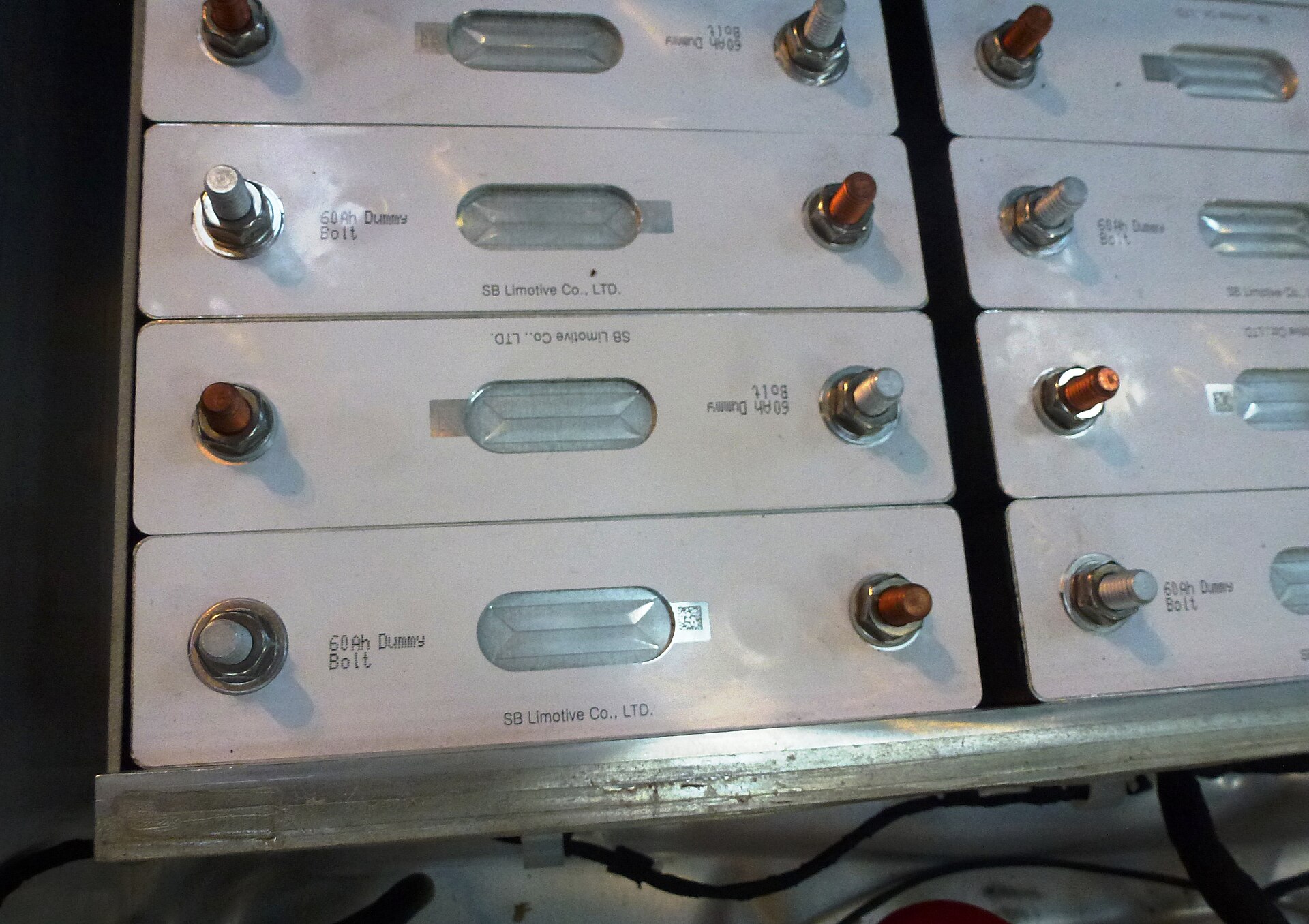
Image credit: Photo: RudolfSimon — CC BY-SA 3.0 (via Wikimedia Commons)
